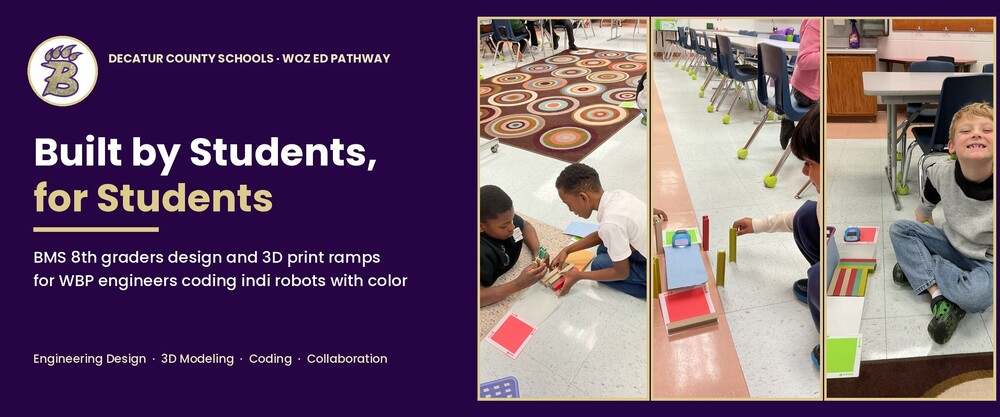
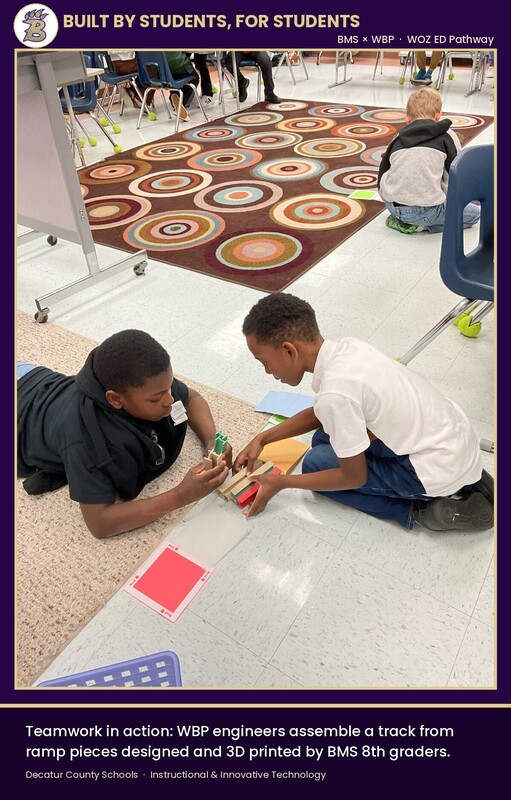
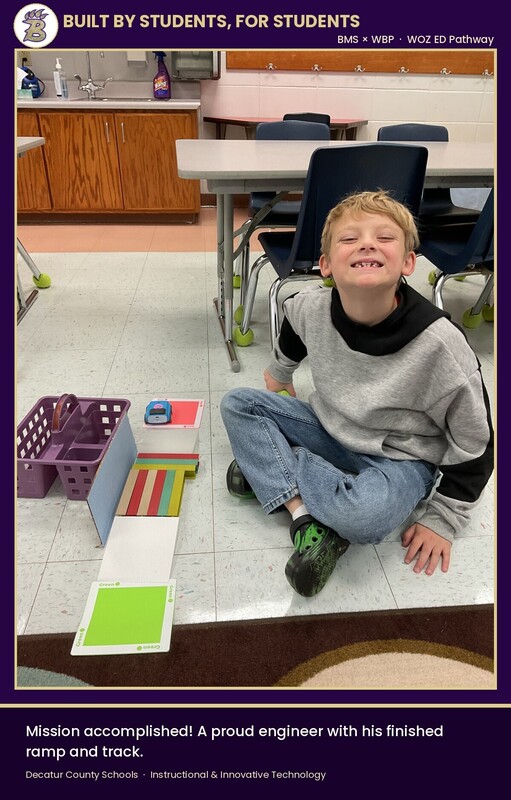
At West Bainbridge Primary, young engineers are sending robots down ramps that older students designed and built for them. The ramps were designed and 3D printed by 8th graders at Bainbridge Middle School in Mary Jo Boutwell's STEAM class. Now they sit on the classroom floor at WBP, where primary students in Cindy Clement's and Carol Watts's engineering classes use them with INDI robots.
The project links two schools and two age groups through one shared challenge. It is also a clear picture of the WOZ ED and technology pipeline Decatur County Schools has built from primary school through high school.
Older students designing for a real user
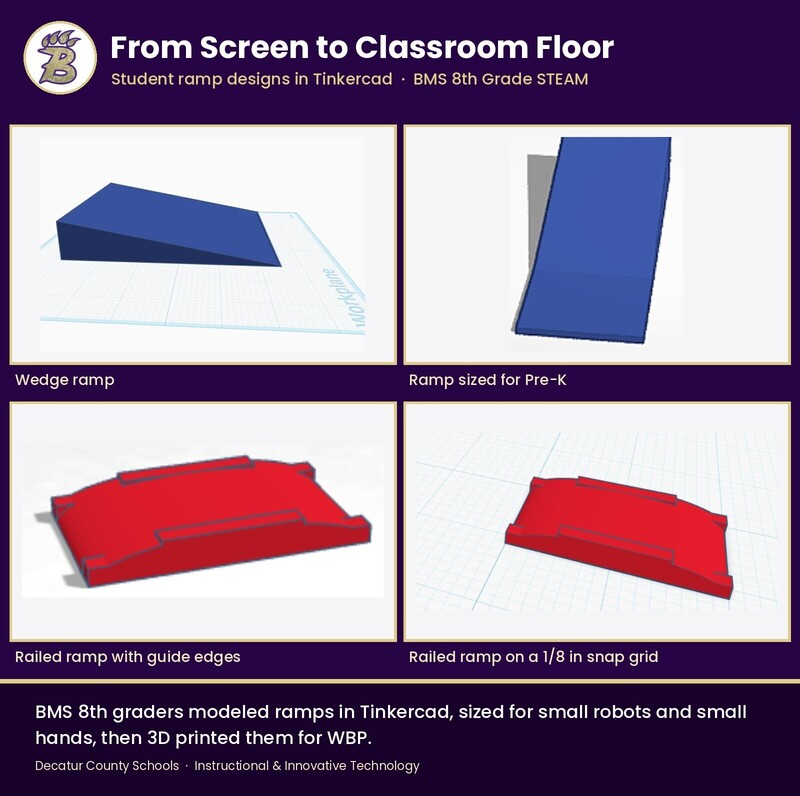
Boutwell's 8th graders started with a real customer: younger students who needed sturdy, colorful pieces to build robot tracks. They sketched ideas, modeled their ramps in Tinkercad, printed prototypes, and refined them until the pieces fit together and held up to small hands. One team even scaled a ramp specifically for Pre-K students.
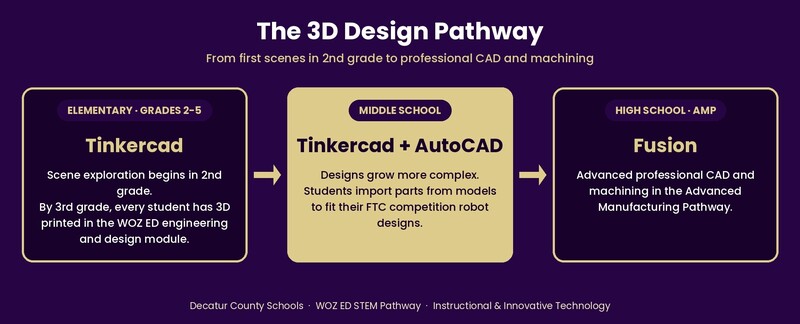
 The project is one stop on the district's 3D design pathway, which starts long before 8th grade. Students begin exploring Tinkercad as early as 2nd grade, building simple 3D scenes. By 3rd grade, every student has successfully 3D printed a design in the engineering and design module of WOZ ED.
In middle school, the work gets more complex. Students move from Tinkercad to AutoCAD and learn to import parts from existing models that work with their robot designs for the FIRST Tech Challenge (FTC) robotics competition. In high school, students in the Advanced Manufacturing Pathway (AMP) progress to Fusion, using advanced professional CAD and machining.
"When our 8th graders sit down in Tinkercad, it isn't their first time," Zock said. "They've been designing since 2nd grade. What's new is the challenge: designing for someone else, with the precision a real user needs. That's exactly the bridge to AutoCAD and Fusion."
 "Our 8th graders weren't printing something to sit on a shelf," said Amy Zock, Executive Director for Instructional and Innovative Technology. "They were designing for a real user, and that user was six or seven years old. That changes how you think about strength, size and safety."
Younger students coding with color
At WBP, students use the ramps with INDI, a small robot with color sensors on its underside that read cards as it drives over them. A green card tells INDI to go. A red card tells it to stop. Other colors can change its speed, turn it, or set off lights and sounds.
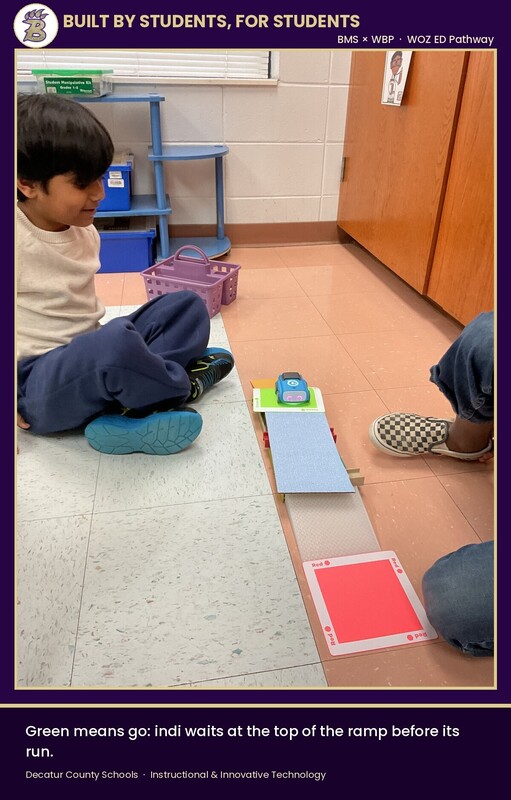
Working in pairs on the classroom floor, students build a track with the 3D printed pieces. They place a green card at the start and a red card at the finish, and set ramps and different surfaces in between. Then they test their design and see what happens.
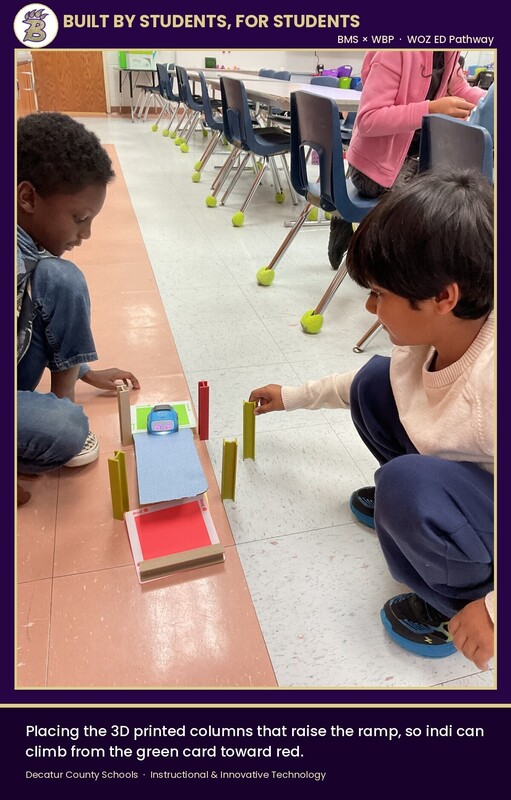 Some teams discovered INDI needed a gentler slope to make the climb. Others tried bumpy and smooth surfaces to see how the robot's speed changed. When a run didn't work, students moved a column, swapped a card, and tried again. That is the engineering design process, at seven years old.
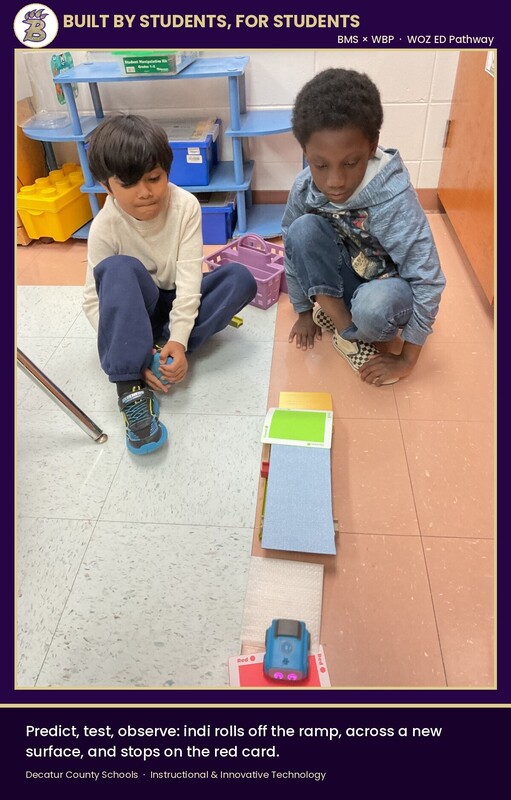
"Watch the faces in these pictures," Zock said. "That's a child predicting what will happen, testing it, and getting it right. Nobody had to tell them they were coding. They just were."
One pipeline, many grade levels
Decatur County Schools is Georgia's first Woz ED STEM Pathway district. The pathway runs through every level: primary students at Jones Wheat Primary and WBP, 3rd through 5th graders at Hutto Elementary, 8th grade rotations at BMS, and computer science courses at Bainbridge High School.
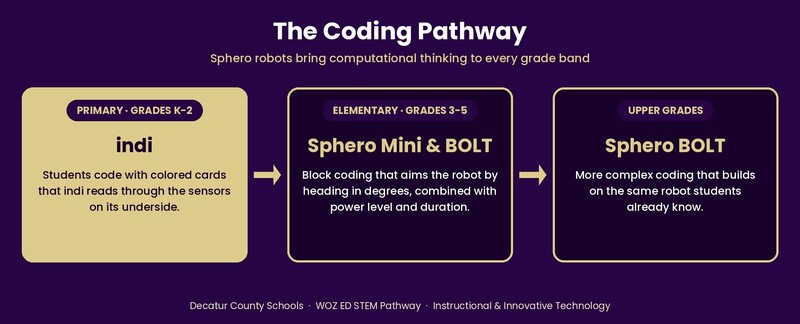
Coding follows its own progression, and Sphero robots are part of it at every grade band. Primary students start with indi and its color cards, coding without a screen. In grades 3-5, students move to Sphero Mini and Sphero BOLT robots, using block coding to aim the robot by heading in degrees and combine that with power level and duration. Later, they take on more complex coding with Sphero BOLT.
"We use these robots at every grade band to bring computational thinking and problem solving into many learning contexts," Zock said. "A student who learns that green means go in 1st grade is ready to think in degrees and duration by 3rd grade."
 This collaboration shows that pathway working in both directions. Primary students get tools made just for them. Middle schoolers see their designs used and tested by a real audience, often by children they may one day mentor on a robotics team.
"A pipeline isn't just a list of courses," Zock said. "It's students at one level building something that helps students at the next. When an 8th grader designs for a 2nd grader, both of them learn what it means to be an engineer."
The district thanks Mary Jo Boutwell and her BMS 8th grade STEAM students, and WBP engineering teachers Cindy Clement and Carol Watts and their students, for showing what is possible when classrooms across the district work together.
Older students using their skills to lift up the younger students coming behind them, and young learners who will one day do the same. That's the Bearcat Way.
"Technology will never replace great teachers, but in the hands of great teachers, it's transformational." — George Couros
Skills spotlight
Use this as a sidebar or callout box beside the article. It shows the technology and STEM skills each group practiced.
Skill area | BMS 8th grade STEAM (designers) | WBP engineering (users and testers) |
|---|---|---|
Engineering design process | Defined a user need, sketched, prototyped, tested and revised parts | Built tracks, predicted results, tested and redesigned after each run |
Computer science | Translated designs into machine instructions for the 3D printer | Programmed INDI with color-card sequences (green = go, red = stop), the first step before block coding Sphero Mini and BOLT in grades 3-5 |
3D modeling and fabrication | Modeled ramps in Tinkercad (the first step toward AutoCAD and Fusion), then set up and ran 3D prints | Assembled modular parts into stable structures |
Math | Measured, scaled and set tolerances so slots fit together | Measured ramp height and track length; compared distances |
Physical science | Designed for strength and load | Explored slope, speed and friction across different surfaces |
Collaboration and communication | Designed for a younger audience's needs and safety | Worked in pairs, shared roles, explained their thinking |
Persistence and problem solving | Iterated when prints failed or pieces didn't fit | Debugged runs by moving a ramp or swapping a card |
Standards connections: Georgia K-12 Computer Science Standards (algorithms and programming, computing systems), Georgia Standards of Excellence for science (engineering design and force and motion), and ISTE Standards for Students (Innovative Designer, Computational Thinker).