
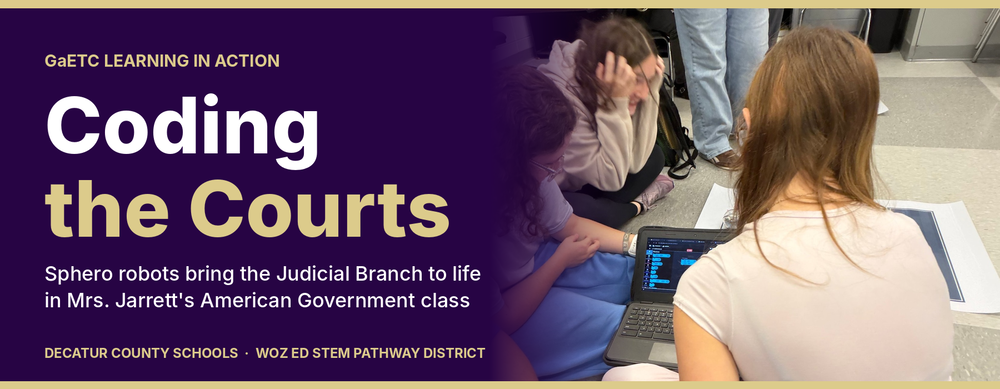
GaETC Learning in Action · Bainbridge High School
Fresh from the Georgia Educational Technology Conference, Mrs. Jarrett turned her American Government classroom into a working map of the federal court system, and her students wrote the code to navigate it.
How does a case travel from a local dispute all the way to the U.S. Supreme Court? In Mrs. Jarrett's American Government class at Bainbridge High School, students don't just read the answer. They program a robot to follow the path bringing the process to life.
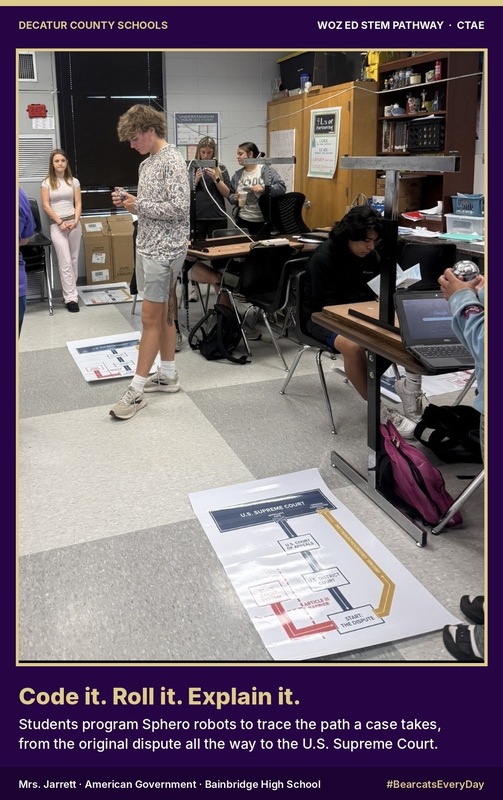
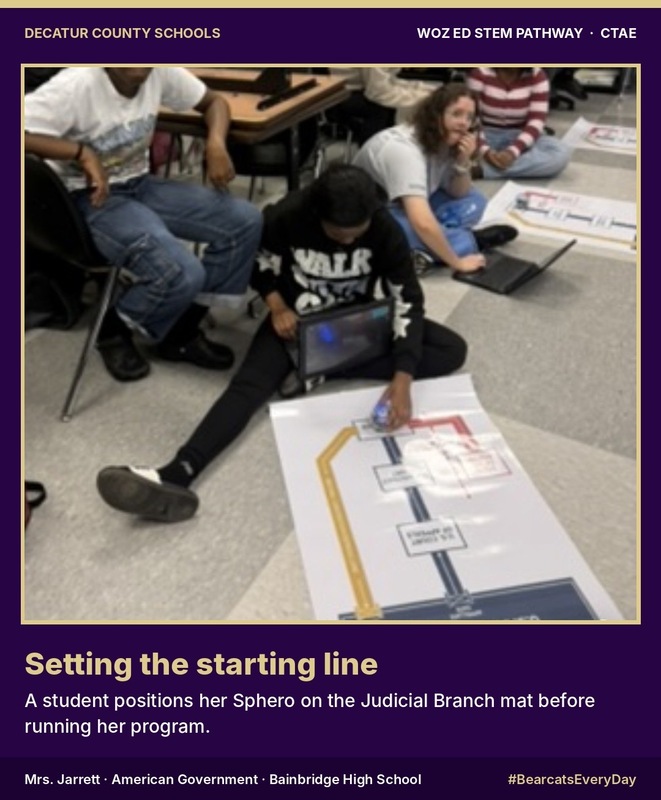
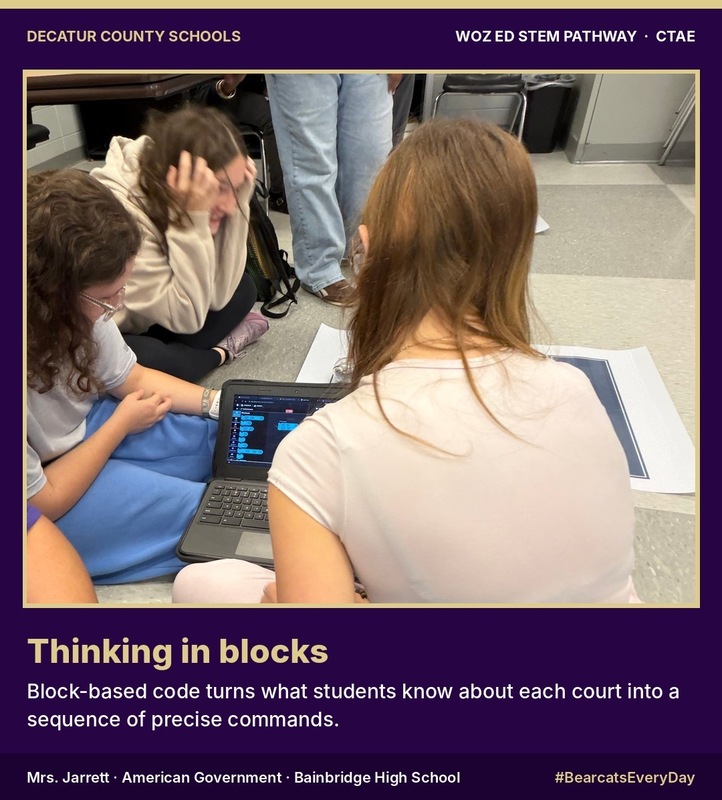
Mrs. Jarrett recently returned from GaETC (Georgia Educational Technology Conference) in Atlanta and wasted no time putting her new learning into action. Her students are studying the Judicial Branch, specifically the characteristics of each court and which types of cases go to each one. To make that learning visible, she paired large Judicial Branch floor mats with Sphero robots, small programmable spheres that students control with block-based code on their Chromebooks and tablets.
Answering questions with code
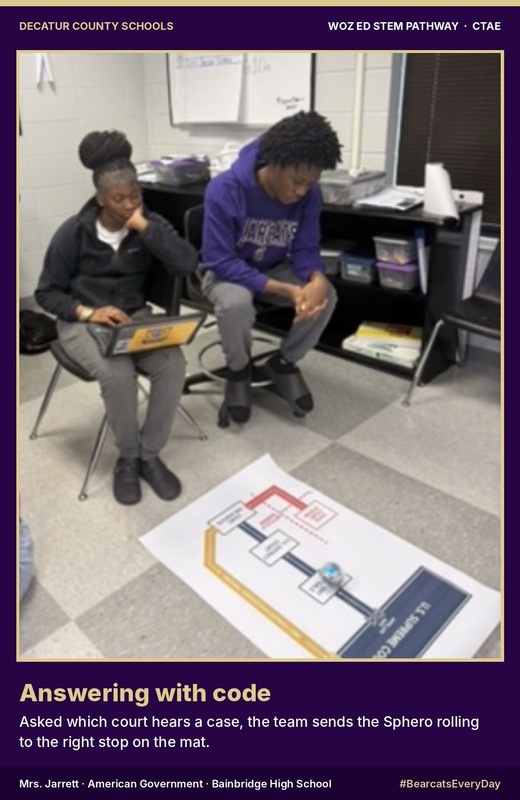
The activity works like a live quiz where the robot gives the answer. Mrs. Jarrett poses a question about the court system, and each team has to work out the answer, program their Sphero to travel to the correct location on the mat, and say the answer aloud. When she asked, "Which court guarantees Sixth Amendment rights?" students ran their programs to send the Sphero rolling to the U.S. District Court, then named the court to the class.
Each mat traces the paths a case can take: from the dispute, through the state court system or the U.S. District Court, on to the U.S. Court of Appeals, and up to the U.S. Supreme Court, with a separate route for original jurisdiction. To get the robot to the right stop, students have to know the content. A wrong answer, or a wrong turn in the code, shows up right away on the floor.
Computational thinking in a social studies classroom
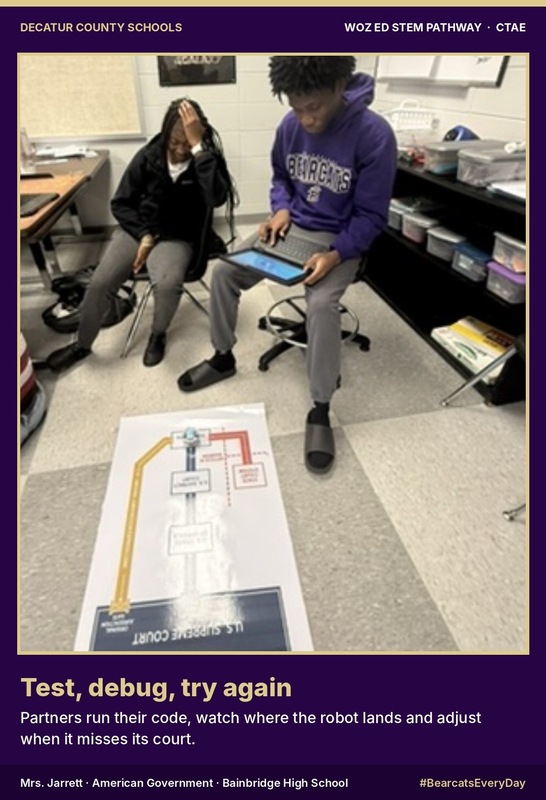
The lesson is a clear example of the computational thinking that runs through Decatur County Schools' WOZ ED STEM Pathway and CTAE pathways. Students broke a big idea (the structure of the federal courts) into smaller parts, put precise steps in order to move the robot, tested their programs, and debugged when the Sphero missed its mark. These are the same problem-solving habits students build in robotics, computer science and career pathway courses, now applied to civics.
As Georgia's first WOZ ED STEM Pathway district, Decatur County Schools is committed to making innovative technology part of everyday learning in every subject, not just STEM classes. When a government teacher can use a robot to teach jurisdiction, students see that coding is a tool for thinking, communicating and showing what they know.
Teamwork behind the scenes
Bringing a new tool into a classroom takes support, and this lesson was a team effort. Mrs. Jarrett credited Bainbridge High School media specialist Mrs. Brock for her help.
"Thank you, Mrs. Brock, for helping me navigate this activity." — Mrs. Jarrett
Teachers learning, bringing that learning home, and students engaged in rigorous, hands-on work: that is what it looks like to lead with intent, learn with purpose, and lift every learner in Decatur County Schools.